The Sea Time and Rest Record
The WorkHarbor workbook for keeping your sea service tally and your hours of rest straight, counted the careful way and backed by paper
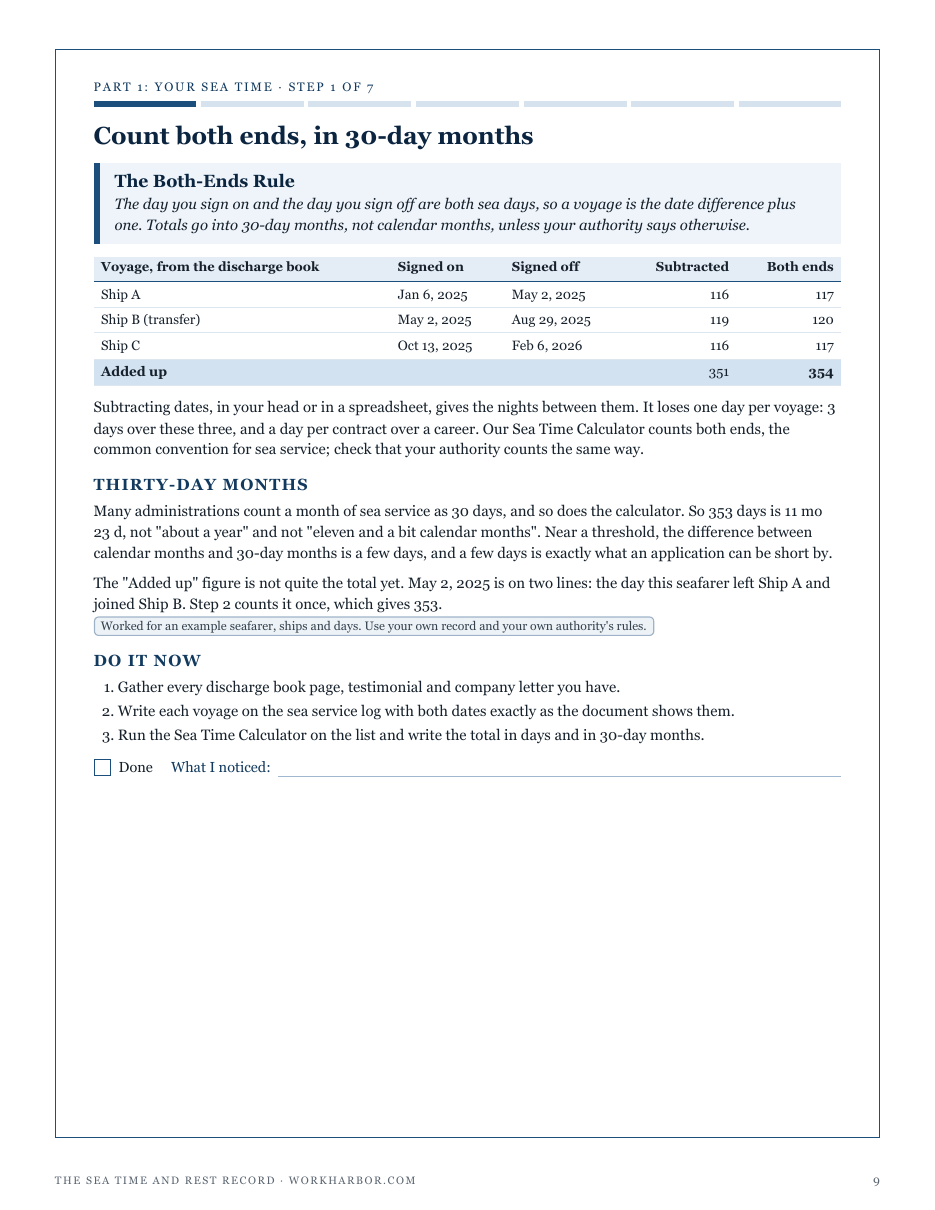
WorkHarbor's Sea Time Calculator added voyages up, so a transfer day on two ships, or one contract shown in both a discharge book and a company letter, was counted twice. The Watch Schedule Planner quoted the rest rules (10 hours in any 24, 77 in any 7 days) but only ever showed hours on watch, never rest, and gave an average even when a watch had nobody in it. Both tools are fixed now; this workbook does the adding up they left to you. Part 1 counts sea time the way certificates are usually counted: both ends of every voyage, each calendar day once, the kind of day (seagoing, port, shipyard, standby) and the ship's certificate figures logged on board, and the target turned into days and contracts. On an example record, three ships and a company letter sum to 422 days; counted once they are 353, or 11 months and 23 days, and planning on seagoing days alone takes 4 more 120-day contracts, not 2. Part 2 reads your watch as rest against the numbers printed in STCW Code A-VIII/1 and MLC 2006 Standard A2.3: a six on, six off day with one drill and an hour mooring holds exactly 10 hours of rest in pieces no longer than 4, and a week of 10-hour days is 73 hours, short of 77. Every worked figure is an example computed from the site's own calculators. The workbook counts and records; it never rules on what sea service qualifies (your maritime administration decides) or says a record complies (your flag state and company decide), and it says nothing about navigation. Included: 24 printable pages with seven steps, a sea service log, a sea time tally, a week of rest in hours, a weekly rest check card, reference tables and a quickstart, plus a personalised sheet worked on the dates or watch system you entered in the calculator you came from.
Look inside
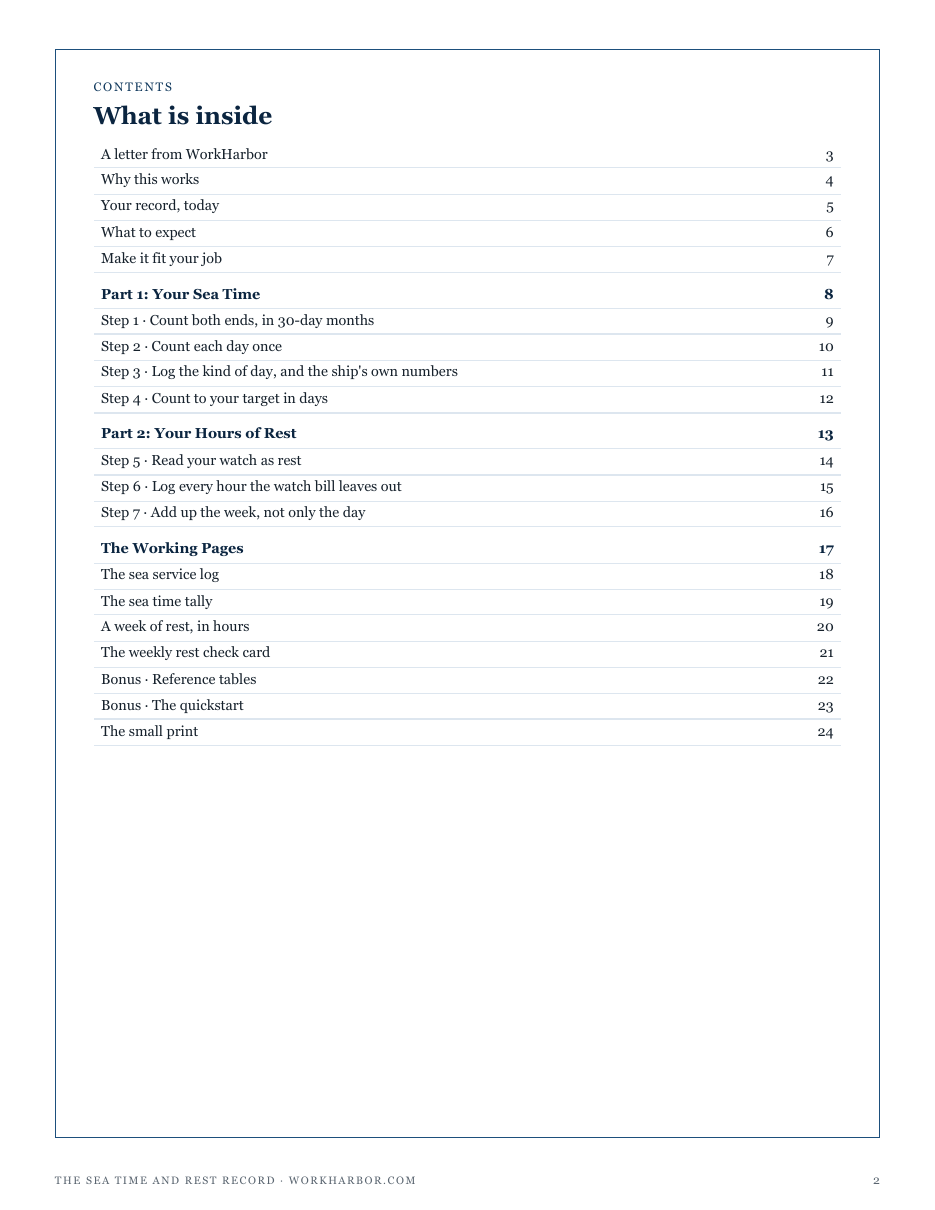
Two full pages from the workbook, exactly as printed. Click either to read it at full size before you decide.
What is in it
- Both ends counted: why subtracting dates loses a day per voyage, and totals in 30-day months
- Each day once: transfer days, overlapping letters and repeated contracts counted once, with the dropped days written down
- The kind of day and the ship's own numbers: seagoing, port, shipyard and standby columns, and GT and kW from the ship's certificates
- Your target in days: what is still needed on each total, and how many contracts that takes when only some days count
- Your watch read as rest: 4 on / 8 off, 6 on / 6 off and dog watches against every printed number, day and week
- Every hour the watch bill leaves out: drills, mooring and cargo work, and the half-hour lunch that decides a day
- The 77-hour week: why 10 hours a day is not enough, and how to raise a short record without ever adjusting it
- A sea service log, a sea time tally, a week of rest in hours and a weekly rest check card
- Reference tables: days to 30-day months, the printed numbers with their paragraphs, and weekly rest by daily figure
- A personalised sheet: your voyages with each day counted once and the days still needed, or your watch read as rest
- ✓ 24 printable pages
- ✓ 10 sections, worksheets and templates
- ✓ A second PDF worked out from the numbers you enter
- ✓ No account needed, just an email address
- ✓ Instant download; link valid 7 days
Price includes any taxes. Sold by GrabURL, who handle checkout and support. The charge appears on your statement as GrabURL.
The workbook picks up where the free Sea Time Calculator leaves off. The calculator adds up your sign-on and sign-off dates; the workbook sets it beside the Watch Schedule Plannerin the order a seafarer’s paperwork needs them: both ends counted in 30-day months, each day counted once, the kind of day and the ship’s certificate figures logged on board, the target in days, your watch read as rest against the numbers printed in STCW and the MLC, every hour outside the watch logged, and the week added up. It counts and records; your maritime administration decides what sea service qualifies, and your flag state and company decide how the rest rules apply. Nothing in it is guidance on navigation.